Wednesday, 9 October 2019

Critical Analysis of "The Scarlet Letter"


Name: Vishva Gajjar
Roll no.: 33
Paper: 10 (The American Literature)
Submit to: English Department (MKBU)

Critical Analysis of “The Scarlet Letter”

·       About Author:

Born on July 4, 1804, in Salem Massachusetts, Nathaniel Hawthorne’s life was steeped in the Puritan legacy. An early ancestor, William Hathorne, first emigrated from England to America in 1630 and settled in Salem, Massachusetts, where he became a judge known for his harsh sentencing. William’s son, John Hathorne, was one of three judges during the Salem Witch Trials in the 1690s. Hawthorne later added a “w” to his name to distance himself from this side of the family.
Hawthorne was the only son of Nathaniel and Elizabeth Clark Hathorne (Manning). His father, a sea captain, died in 1808 of yellow fever while at sea. The family was left with meager financial support and moved in with Elizabeth’s wealthy brothers. A leg injury at an early age left Hawthrone immobile for several months during which time he developed a voracious appetite for reading and set his sights on becoming a writer.
After 1860, it was becoming apparent that Hawthorne was moving past his prime. Striving to rekindle his earlier productivity, he found little success. Drafts were mostly incoherent and left unfinished. Some even showed signs of psychic regression. His health began to fail and he seemed to age considerably, hair turning white and experiencing slowness of thought. For months, he refused to seek medical help and died in his sleep on May 19, 1864, in Plymouth, New Hampshire. 

Nathaniel Hawthorne was an American short story writer and novelist. His short stories include "My Kinsman, Major Molineux" (1832), "Roger Malvin's Burial" (1832), "Young Goodman Brown" (1835) and the collection Twice-Told Tales. He is best known for his novels The Scarlet Letter (1850) and The House of the Seven Gables (1851). His use of allegory and symbolism make Hawthorne one of the most studied writers. 
·       About Novel:
This novel is set in the theocratic and patriarchal Puritan society of the Massachusetts Bay Colony. The year is 1642, which means that this particular group of colonists settled in the area of Boston, and were part of a second wave of settlers that came from England in 1630 with the purpose of purifying the Church of England. 
Ø Character:
Aurthur Dimmesdale
General Miller
Governor Bellingham
Hester Prynne
Inspector
John Wilson
Mistress Hibbins
Pearl
Roger Chillingworth

·       Critical Analysis:
Although Hawthorne wrote to his friend Bridges that he thought ‘The House of the Seven Gables’ was a better book than ‘The Scarlet Letter’, most modern critics consider ‘The Scarlet Letter’ to be his masterpiece. In fact, evidence of the continued popularity of his works, even among people not usually concerned with literary works, appeared in two 1984 issues of the New England of Medicine.
Jemshed A. Khan a physician, suggested that Dimmesdale was a victim of atropine poisoning, administered by Chillingworth. He supports his claim by citing Hawthorne’s mention of plants which contains the poison and he concludes, the symptoms experienced by Dimmesdale-the hallucinations, the convulsions, the tremors and the red stigmata of guilt, which some witnesses describes as being chest at the close of the novel-are all consistent with the known symptoms of atropine poisoning. Three rnonths later the same journal carried a series of letters both in praise of critical of— Khan's views. 'I'hat such a furor could be generated among— arid present day readers by a novel written more than a hundred and thirty years ago is ample tcstimony to the power of T Hawthorne’s novel and its continuing popularity.
In an entirely different vein, yet one that is worth investigating one should consider a theory recently advanced by another scholar Hawthorne, as noted, was always concerned with his family history and with colonial history. His earliest American ancestor, William Hawthorne, arrived in this country with John Winthrop, later governor of the Massachusetts Bay Colony, in 1630. Hathorne became the Speaker of the House of Delegates and was also a major in the Salem militia. This "steeple-crowned progenitor" who 'had all the Puritanic traits, both good and evil," was remembered by the Quakers for an 'incident of his hard severity towards a woman of their sect." Even Hawthorne thought that the memory of his ancestor's severity toward the woman would "last longer, it is to be feared, than any record of his better deeds."
William's son, John, became even more famous —or infamous. He was one of the three judges in the Salem witchcraft trials of 1692. It is he who is mentioned in the "Custom House" section of The Scarlet Letter as having "made himself so conspicuous in the martyrdom of the witches, that their blood may fairly be said to have left a stain upon him." Hawthorne's reaction to the early history of these two ancestors may well have led him to declare that "I, the present writer as their representative, hereby take shame upon myself for their sakes and pray that any curse incurred by them . . . maybe now and hence forth removed."
For many readers, the shame which Hawthorne took upon himself, as a result of the actions of his paternal ancestors, has been enough to account for what he designates as one of the "many morals" which Dimmesdale's experience might provide for the reader. That moral is placed by Hawthorne in the final chapter of the novel where he writes, 'Be true! Be true! Show freely to the world, if not your worst, yet some trait where inferred" Interestingly, as mentioned earlier, a number of scholars have looked further into Hawthorne's family history, past the apparent "sins" of his paternal ancestors, believing that the witch-hunting fervor of these long-dead relatives was not a sufficient cause of Hawthorne's strong protest for us to "show… if not the worst, yet some trait whereby the worst may be inferred!" They have sought elsewhere for the possible explanation for the fevered moral which Hawthorne makes so impassionately.
For example, in 1984, the critic Philip Young published. Hawthorne’s Secret, arguing that Hawthorne quite probably uncovered a bit of startling information related to his maternal ancestors that would account for the impassioned moral in the last chapter of The Scarlet Letter.
In the "Quarterly Court Records" of Essex Country, Massachusetts, Hawthorne may well have found the records of a court case which took place on March 29, 1681. Two of Hawthorne's maternal ancestors, Anstis and Margaret Manning, were convicted of having committed incest with their brother, Nicholas. They were sentenced to be publicly whipped and to stand in the middle of the Salem meeting house with a paper on their heads revealing the nature of their crime. The substitution of an adulterous for an incestuous relationship could indeed be a case of showing "some trait whereby the worst may be inferred."
This sort of scholarly research can hardly be said to provide absolute proof that Hawthorne was aware of that particular aspect of his ancestors' history, but it does again demonstrate that there is still a great interest in The Scarlet Letter and in Hawthorne's motivations for writing it.
As one considers those two recent speculations, one should also consider more mundane, but certainly valuable aspects of Hawthorne's masterpiece. It is important, for example, to know that when Hawthorne finished The Scarlet Letter, he had already written most of the works that were to make him famous. Thus, many of the stylistic techniques and themes which are characteristic of a work by Hawthorne were already a habitual art of his style. Those elements include: (1) Hawthorne’s theory of the romance as a literary form; (2) Hawthorne's use of symbolism in the novel; (3) Hawthorne's style; (4) Hawthorne's use of historical materials and figures as part of the setting; and, finally, (5) Hawthorne's use of ambiguity.
Turning to The Scarlet Letter, one finds that Hawthorne continued to use this device of ambiguity to defuse the skeptical objections of his “common-sensible" readers. At the end of Chapter 8, while discussing the significance of Hester's conversation with Mistress Hibbins, Hawthorne inserts this qualifying phrase: ". . . if we suppose this interview betwixt Mistress Hibbins and Hester Prynne to be authentic, and not a parable." In Chapter 12, while describing the scarlet A which Dimmesdale (and according to the sexton and others as well) saw in the sky, Hawthorne remarks: "We it…solely to the disease in his own eye and heart, that the minister, looking upward to the zenith, beheld there the appearance of an immense letter, —the letter A-marked out in lines of dull red light.
In all of these cases, Hawthorne leaves the solution to the reader; the reader must decide what is "literally true." It seems as if Hawthorne wishes to make use of the supernatural or fantastic devices for symbols, but also offers an optional explanation for the literal-minded reader to whom the fantastic is not justified—not even for an artistic effect Actually, Hawthorne's method of narration gives him the best of two worlds. He is somewhat like the trial lawyer who withdraws a telling remark upon the judge's objection, but knows that the implications of his remark will remain in the minds of the jury members.
Hawthorne’s final touch of symbolism lies in the slate tombstone which serves for both graves. Hawthorne uses the language of heraldry to describe the letter A, which is engraved on it and which “might serve for a motto and a brief description of our now concluded legend”. He describes the tombstone as being somber and brightened only by one ever-glowing point of light, the scarlet letter A. A Herald’s description of the tombstone might read: “On a Field, Sable, the Letter A glues,” which is translated into modern English as, “On a black background, the scarlet letter A.

Liberal Humanists: the 'Bloomsbury' Group

Name: Vishva Gajjar
Roll no.: 33
Paper: 9 (The Modernist Literature)
Submit to: English Department (MKBU)

Liberal Humanists: the ‘Bloomsbury’ Group

·       The Modern Period:

The modern period traditionally applies to works written after the start of World War 1. Common features include bold experimentation with subject matter, style, and form, encompassing narrative, verse, and drama. W.B. Yeats’ words, “Things fall apart; the center cannot hold” are often referred to when describing the core tenet or “feeling” of modernist concerns. Some of the most notable writers of this period, among many, include the novelists James Joyce, Virginia Woolf, Aldous Huxley, D.H. Lawrence, Joseph Conrad, Dorothy Richardson, Graham Greene, E.M. Forster, and Doris Lessing; the poets W.B. Yeats, T.S. Eliot, W.H. Auden, Seamus Heaney, Wilfred Owens, Dylan Thomas, and Robert Graves; and the dramatists Tom Stoppard, George Bernard Shaw, Samuel Beckett, Frank McGuinness, Harold Pinter, and Caryl Churchill. New Criticism also appeared at this time, led by the likes of Woolf, Eliot, William Empson, and others, which reinvigorated literary criticism in general. It is difficult to say whether modernism has ended, though we know that postmodernism has developed after and from it; for now, the genre remains ongoing.

·       The Postmodern Period:

The postmodern period begins about the time that World War II ended. Many believe it is a direct response to modernism. Some say the period ended about 1990, but it is likely too soon to declare this period closed. Poststructuralist literary theory and criticism developed during this time. Some notable writers of the period include Samuel Beckett, Joseph Heller, Anthony Burgess, John Fowles, Penelope M. Lively, and Iain Banks. Many postmodern authors wrote during the modern period as well.


·       Characteristics:
1.      In contrast to the Romantic world view, the Modernist writers care little for nature.
2.      In their literary works, The Modernist writers were interested in deeper reality than surface reality.
3.      Most of the literary works of the Modern Age were influenced by the disillusionment that came after the World War II
4.      Irony, satire and comparisons are used frequently to illustrate points used frequently to illustrate points in regard to society.
5.      Modern Literature with its modern themes and techniques appeared as a reaction against the Victorian Age with its restrictions and traditions.
6.      Modernist fiction spoke of inner self and consciousness and many writers of that age adapted the stream of consciousness technique in their writings, such as James Joyce in his literary work: Ulysses
7.      Earlier, most literature had a clear beginning, middle and end, the Modernist story was often a more of a stream of consciousness.

·       The ‘Bloomsbursy’ Group:
The Bloomsbury Group was a circle of writers, artists and intellectuals from the Bloomsbury district of London. The Bloomsbury Group originally started off with 10 members and later expanded:
Virginia Woolf, writer
E.M. Forster, writer
Lytton Strachey, writer
Leonard Woolf, writer
Roger Fry, artist
Vanessa Bell, artist
Clive Bell, art critic
John Maynard Keynes, economist
Duncan Grant, artist
Desmond McCarthy, journalist
The “Bloomsbury’s,” as they were called, were mostly privileged and well-educated members of the upper middle class. Yet, what separates them from other intellectual groups at the time was that they were the only group to support gay rights, women in the arts, pacifism, open marriages, uninhibited sexuality and other unconventional ideas. Having grown up in Victorian households, the Bloomsbury Group openly rejected the old Victorian ideals from their childhoods and adopted more liberal and progressive attitudes.
Seeing Victorian society as prudish and narrow-minded, they chose to live freely and unrestricted. As the book “Great World Writers: Twentieth Century” explains: “In short, they were determined to reinvent society, at least within their own circle.”
THE REVOLT AGAINST the Victorian age can be seen as a conflict of generations. VIRGINIA WOOLF (1882—1941) will be among that select company of writers who outlive their time. At sent there is a note of uncertainty in most critiques of her work. Yet to have been a genius in some sense in which Lytton Strachey not, and in which even E. M. Forster was not. She belongs to the company of Henry range and scale of her work is so much smaller that comparison is difficult. Woolf was the daughter of Sir Leslie Stephen, the distinguished critic. She was brought up partly in London and partly in Cornwall. She married Leonard Woolf in 1912 and collaborated with him in the Hogarth Press, which pioneered the publication of experimental and controversial writers. Her early novels, The Voyage Out (1915) and Night novels and included Day Mrs. (1919), Dalloway were followed (1925), by To Jacob's the Lighthouse Room (1922). (1927), Later the Waves (1931), The Years (1937), and Between the Acts, which was published posthumously in 1941. Virginia Woolf was a born writer. Forster said of her that 'she liked writing with an intensity that few writers have attained, or even desired'. She derived many of her ideas from her circle and in this circle personal relationships, it seems, tended to lack depth and stability. This may partly account for the bloodless grace and cool detachment of her work. Yet in her best novels, To the Lighthouse and The Waves, we feel that her relationship with a few people mattered deeply to her. Her essential subject-matter may not differ as much as it seems to do from that of the traditional novelist. But her way of presenting it is very different. She tried to capture in her style the actual experience of life as it is lived, the flow of perceptions from moment to moment, a thought as it is actually thought, and a feeling as it is actually felt
 Woolf's first novel of promise was Night and Day. This novel is rather neglected, because its main themes are developed more convincingly in To the Lighthouse. And it remains on the whole faithful to the traditional form of the old-fashioned novel, which she was later to ridicule. Her new technique first appears in Jacob's Room, in which she draws an impressionistic sketch of a volatile young man. Mrs. Dalloway, which followed, raises the question of Mrs. Woolf's debt to Joyce. Six lives, in essence, are shown in a cross-section of time—one day in the neighborhood Of Bond Street.
By the late twenties Woolf had become the center of a cult. Her idiosyncrasies deterred readers accustomed to ordinary novels. As her journals show, Woolf was very concerned with the barometer of her own reputation, and it is possible that in the fantasy Orlando (1928), and the novel The Years (1937), she attempted to reach a wider public. But neither shows her strength as an artist. The Years looks like a compromise between the method of the ordinary novel and Mrs. Woolf's own poetic method of creation. As such, it is disappointing, and often strangely lifeless, as if Mrs. Woolf had exhausted her subject-matter.
It was in The Waves (1931) that Woolf wrote her last successful novel. This is the most experimental of her novels, the farthest from conventional notions of character, story, and plot. It shows, in semi dramatic structure, a group of characters at certain stages in their lives, different times and seasons. It is a prose poem, held together by the symbolic use of the sea, recurrently punctuating the sextet of voices with its sound and movement. The Waves is a strange book. It is as if someone were to write down their dreams, very poetically, but without comment or interpretation. The only clue to its meaning lies in Woolf's obsession with death. At the end the sea, which stands for death, has the last word: 'the waves broke on the shore'. In To the Lighthouse and The Waves the preoccupation with death is overpowering. But we also have the sense that Woolf was groping for insights of a glory that transcends the flux of change and time. She seems to have sensed that this glory did not belong to works of art or human beings in themselves, but was merely a reflection of another glory that is not in this world. Virginia Woolf, daughter of the Leslie Stephen of An Agnostic's Apology, never came near any sort of reconciliation with formal religion. But her two best novels convey her sense that the mutability which obsessed her was not ultimate and absolute. Had she survived her last illness, her art might have taken a new direction. But her last, unrevised novel, Between the Acts (1941), is aimless and drifting.
By the 1930s, the Bloomsbury group began to fall apart. Several members died suddenly, including Lytton Strachey in 1931, followed by Dora Carrington’s suicide shortly after and Roger Fry’s accident in 1934.
In 1937, the death of the first Bloomsbury group child, Julian Bell, hit the group especially hard. In 1941, with the possibility of a Nazi invasion looming and suffering from another bout of depression, Virginia Woolf killed herself. John Maynard Keynes died five years later in 1946 and Leonard Woolf passed away in 1969. The last surviving member of the group was Duncan Grant, whose death in 1978 officially brought the Bloomsbury group to an end.

English Language Teaching (Presentation)

The Post - Colonial Studies (Presentation)

The American Literature (Presenting)

The Modernist Literature (Presentation)

Sunday, 6 October 2019

“RANG MOHAN” - Youth Festival 2019


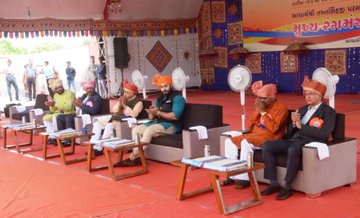
Here I wish to share my experience. Youth festival is one of the best festivals in which university or specific college gives you the opportunity to perform or to show your skill or talents in different fields. It is very important that someone observe your skill and motivate you or encourage you to do more and gives you platform were the talent is valued . So Maharaja Krishnakumarsinhji Bhavnagar University had organized a four-day youth festival and given the name "RANG MOHAN” and the theme of YOUTH FEST was “RANG MOHAN” attributed to 150th Birth Anniversary of Mahatma Gandhi.  It's up to you how you interpret this title. In this festival there, the university organized various events and there were many participants from various colleges. It is very interesting to meet new people or to know something new or we can learn as well. 

Sir always encourage us to participate in every event and to learn something or to have experience of it. So, our from the department, students participated in various events. I didn't participated in event, but I was there as a volunteer and I got to learn many new things and also how to handle the situation and the crowd. My other classmates were also there as a volunteer named Ashish and Krishna who handled all the situations and events very well.


The first event was Kalayatra. In the event, I found many interesting themes. 


 After that, on the second day, we had Inauguration Function in the amphitheatre of MKBU campus. In this function I only found one best performance, the folk orchestra was performed by GTU students. I really enjoyed this performance. After that, various competitions were held at the Campus.
 On the second day, there was an event like Mimicry, Spot Painting, One-act Play, Quiz, Poetry Recitation, Folk Dance, Paper Collage, Mime, Bhajan. 
On the third day, the university organized the events such as Classical Dance, Elocution, Essay writing, Mono acting, Mehendi, Mono acting, Rangoli, Photography, Falk song, Clay Modeling, Poster Making etc.
In the final day, the university organized the events such as Installation, Skit, Group Song and the valedictory Function.


SKIT :

I would like to congregate my class for the best performance. Hina, Nirali, Alisha, Prinjal, Nasim, Monica participated in the Skit competition under the guidance of Alpa Ponda and Kaushal Trivedi performed an extraordinary skit on LGBT theme. We have to think about LGBT. When we watch, at that time you may feel Catharsis or as we know that in skit they give us one important massage.


Bhajan competition :
In bhajan competition, Nasim Gaha from Department of English participated in the event to showcase her vocal skills. She performed a well.


SPOT PAINTING :

Topics for Spot painting are Festival of Ganesha, war and peace, and village of Bhavnagar. In this competition, Kavisha Alagiya participated from Department of English.


Overall, we enjoyed a lot. Thank to our university that organised this wonderful Four Day Rana Mohan festival.